Machinery and equipment transport from Italy
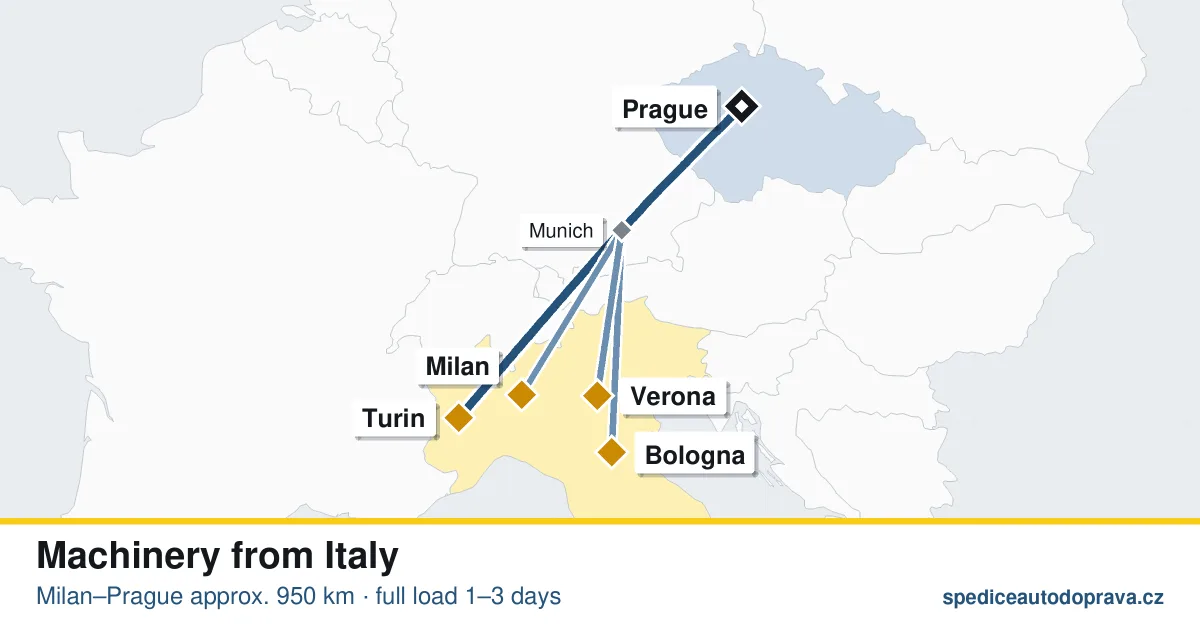
Machinery from Italy usually travels to the Czech Republic on a curtainsider that can be loaded from above by crane once the roof is slid back, or from the side by forklift; smaller machines go on a truck with a hydraulic tail lift. The choice of vehicle depends on weight, dimensions, centre of gravity and the loading options at the manufacturer. A full load from northern Italy takes roughly 1–3 days; Milan to Prague is about 900 km.
Where we collect machinery in Italy
Italian mechanical engineering is concentrated mainly in the north. Lombardy and Piedmont are home to makers of machine tools and metal-forming equipment, Emilia-Romagna around Bologna is a well-known centre for packaging machinery, and Veneto has manufacturers of machines for woodworking, food processing and other industries. From northern Italy the route to the Czech Republic usually runs over the Brenner Pass and through Austria; from eastern Veneto and Friuli also via Tarvisio and Villach.
How the machine is loaded
We need to know the loading method before booking the vehicle, as each one requires different equipment.
| Loading method | Suitable for | What we need to know |
|---|---|---|
| crane from above (sliding roof) | heavy and tall machines, overhead or mobile crane at the manufacturer | weight, dimensions, lifting points |
| forklift from the side | machines on pallets or skids | forklift capacity at collection and delivery |
| from the rear via a dock | smaller machines and parts on pallets | dock height, pallet truck |
| tail lift | lighter machines where there is no dock or forklift | weight and size within the lift’s capacity |
Securing the machine correctly
A machine has a high centre of gravity and small contact areas, so braking and cornering put large forces on the lashings. The applicable standard is EN 12195-1. In practice this means:
- Anti-slip mats under every contact surface of the machine.
- Chains or straps attached to the machine’s lashing points, never over fragile covers or control panels.
- Blocking – timber chocks or barriers against forward and sideways movement.
- Weight distribution – position heavy machines so that no axle is overloaded.
How to prepare the machine
- secure moving parts so they cannot shift in transit,
- drain operating fluids or make sure they cannot leak,
- protect bright metal surfaces against corrosion, for example with VCI film,
- consider a wooden crate or skids for sensitive machines.
Send us a drawing or photo of the machine with the lifting points marked and the weight stated, and we will propose the vehicle and securing method. If the machine is split into several pieces, number them and attach a packing list – this makes checking on delivery, and any claim, much easier. Inspect the machine before the truck leaves and note visible damage on the CMR.
Oversized machinery
If the machine and vehicle together exceed standard dimensions – 2.55 m wide or about 4 m high – or the permitted weight, it becomes an abnormal load. That requires a permit in every country on the route – Italy, Austria, possibly Germany and the Czech Republic – and sometimes an escort vehicle. Depending on the country, permits can take several weeks. We assess such jobs individually and give only an indicative price and date, after checking the route and permits.
Documents
Italy is in the EU, so new and used machinery alike travels duty-free with an invoice and a CMR consignment note. For valuable machinery we recommend cargo insurance, because the carrier’s liability under CMR is limited and based on the weight of the consignment.
We often bring building materials from northern Italy too – see tiles, stone and building materials. Get an indicative price for machinery transport in the calculator; add the dimensions, weight and loading method in the notes.