Freight from Ireland to the Czech Republic – direct ferry or UK landbridge
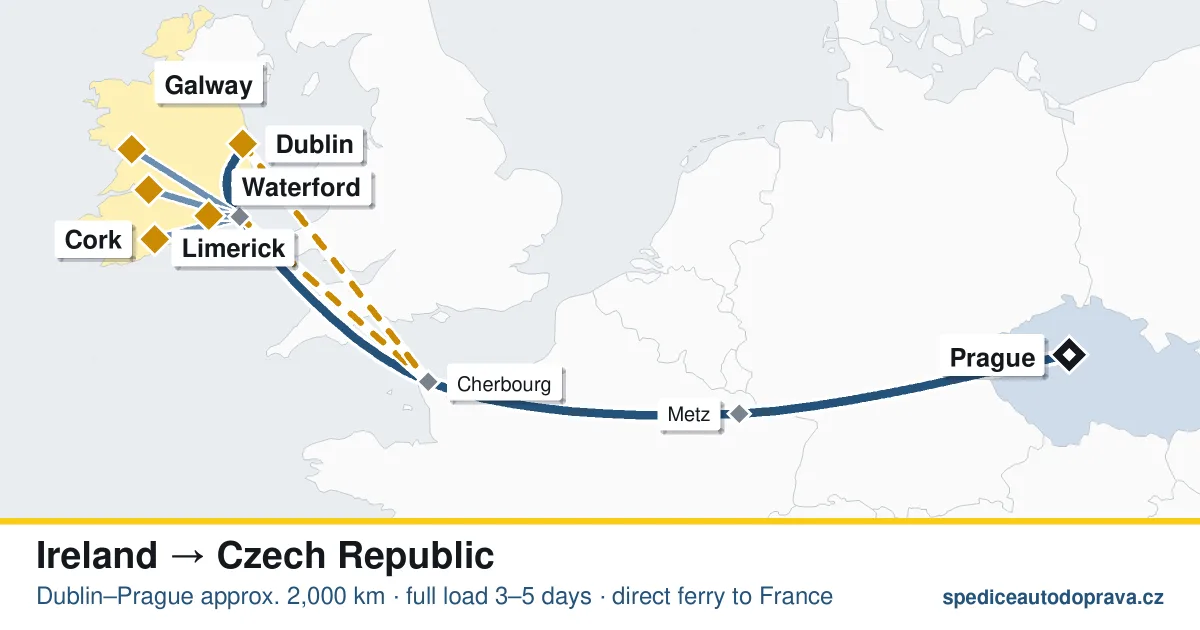
We usually move goods from Ireland to the Czech Republic on a direct ferry from an Irish port to France, so the truck never enters UK customs territory. The alternative is the shorter landbridge through Great Britain, which requires a transit declaration. Dublin to Prague is about 2,000 km and a full truckload takes roughly 3–5 days; check the calculator or ask us for a quote by e-mail.
The Irish cities we collect from for the Czech Republic
Ireland’s economy is heavily export-driven, and production for overseas markets is concentrated in a handful of cities in the east, south and west of the island. Each has its own profile and therefore its own transport needs:
| City | Industry | What we typically carry from there |
|---|---|---|
| Dublin | pharmaceuticals and biotech, food and drink | medicines, whiskey and cream liqueurs, food |
| Cork | pharmaceuticals and biotech, dairy, distilling nearby | medicines and active ingredients, butter, cheese, milk powder, whiskey |
| Galway | medical devices | catheters, stents and other medical supplies |
| Limerick | medical devices, electronics | medical supplies, electronic components |
| Waterford | pharmaceuticals, medical plastics | medicines, pharmaceutical packaging and components |
Medicines travel in temperature-controlled trailers with evidence that the range was maintained. Medical supplies from the west are light but valuable, often just a few pallets. Butter, cheese and beef from the south need a reefer, while milk powder travels perfectly well on a curtainsider. Whiskey and cream liqueurs are excise goods that move under an electronic e-AD, explained on wine and beverage transport.
Direct ferry or UK landbridge?
Since the United Kingdom left the EU, choosing the route has become the key decision for every Irish consignment:
| Direct ferry Ireland–France | Landbridge via Great Britain | |
|---|---|---|
| Crossing | Dublin or Rosslare – Cherbourg, Rosslare – Dunkirk, Cork – Roscoff | across the Irish Sea to Wales or England, by road through Britain and over the Channel to France |
| Customs formalities | none, the goods stay in the EU throughout | NCTS transit document, guarantee and pre-registration on the UK goods vehicle system |
| Time at sea | about 15–24 hours, the driver takes their rest on board | two shorter crossings plus the drive through Britain |
| Risk of delay | fewer sailings a week, booking required | border checks and possible queues at the ports |
For most loads we recommend the direct ferry: the paperwork is simpler, and the long crossing counts towards the driver’s mandatory rest. The landbridge makes sense for urgent goods when the shipper routinely lodges transit declarations. Unaccompanied trailers also sail from Ireland to ports in Belgium and the Netherlands, where a tractor unit takes them on.
What transit through Britain involves
- Before departure, a transit declaration is opened in Ireland in the NCTS system, backed by a financial guarantee.
- On the British side, the movement has to be pre-registered on the UK’s goods vehicle system.
- Only EU goods may be on board; adding a consignment collected in Great Britain would turn the whole load into an import.
- The transit is closed at a customs office in the EU, usually in France or at the final destination.
A word on Northern Ireland
Belfast and the rest of Northern Ireland are part of the United Kingdom, and goods from there follow special arrangements. This page covers freight from the Republic of Ireland; if collection is in Northern Ireland, please say so in your enquiry and we will look at the process separately.
Pallet counts and vehicle choice
For 1–6 pallets of medical supplies or samples, groupage is a good fit, though it takes longer than a full load. For 7–18 pallets we arrange a part load, and from about 18 pallets a full 13.6 m trailer. From France the truck continues by road through Germany, where vehicles over 7.5 t may not run on Sundays and public holidays – so a ferry arriving on a Saturday is planned with a buffer. For an indicative price see the freight calculator; the route across France is described on freight from France, and every country is listed in the EU overview.