Freight from Spain to the Czech Republic
We arrange full loads, part loads and single pallets from Spain to the Czech Republic – from Catalonia, the Basque Country, Aragon, Madrid, Valencia and Andalusia. A full truck from Madrid to Prague (about 2,250 km) takes roughly 2–4 days; groupage takes longer. Goods from mainland Spain and the Balearics need no customs clearance; only the Canary Islands, Ceuta and Melilla follow different rules. Our calculator gives an indicative price and we email a firm quote.
Eight Spanish cities we load in most often
Spain is far more than vegetables and tiles – manufacturing stretches from Galicia to Catalonia. Where the goods are collected also decides the trailer, so we note it alongside the cargo.
| City | Industry | What we typically carry from there |
|---|---|---|
| Barcelona and Tarragona | chemicals and petrochemicals, cosmetics, pharmaceuticals, motor industry | plastics and chemical raw materials (often ADR), cosmetics, food ingredients |
| Madrid | distribution, pharmaceuticals, food processing | stock from retailers’ central warehouses, medicines, packaged food |
| Valencia | motor industry, furniture, agriculture | car parts, furniture (bulky items in a mega trailer), citrus fruit; footwear and toys from around Ibi in Alicante province |
| Zaragoza | car plant, a vast logistics park | components for car makers and stock from distribution centres, by curtainsider or mega trailer |
| Bilbao | steel, machine tools, engineering | machinery and steel products on a sliding-roof curtainsider for crane loading |
| Castellón de la Plana | ceramics and glazes | wall and floor tiles – heavy pallets that max out the trailer by weight |
| Vigo | car plant, fish processing, granite quarried nearby | car parts, frozen fish and seafood in a freezer trailer |
| Almería | glasshouse farming, marble quarrying at Macael | vegetables by reefer, marble slabs on a curtainsider |
Individual product groups have pages of their own: fruit and vegetables, tiles from Castellón, furniture, car parts and food.
Two ways across the Pyrenees
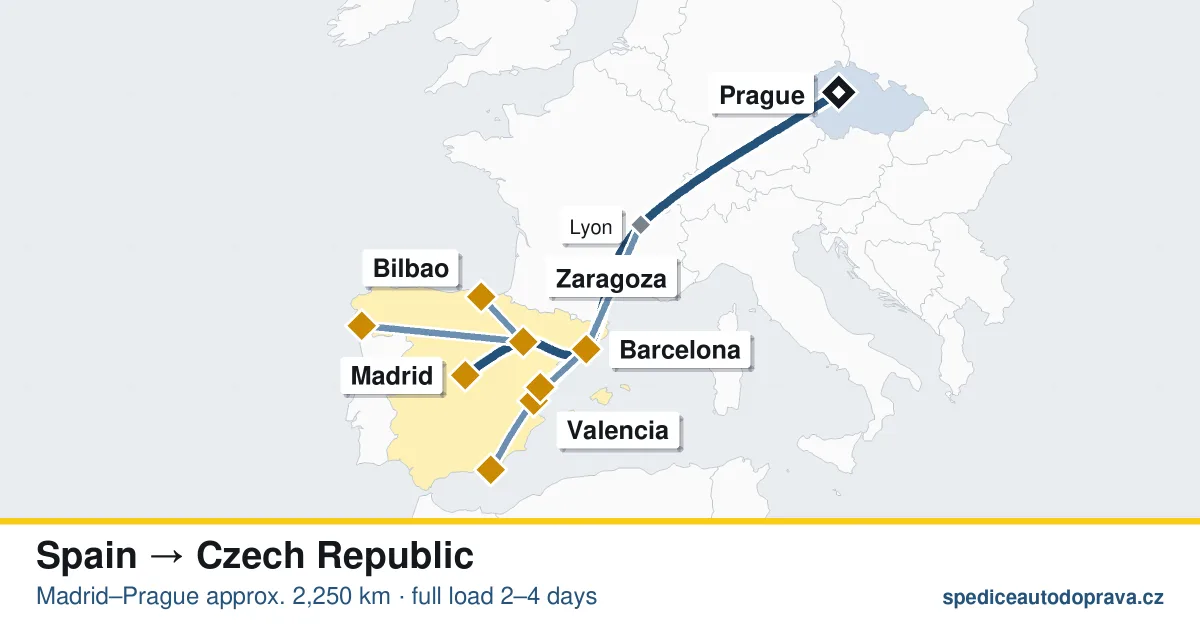
Loads from Catalonia, Valencia, Murcia or Andalusia follow the Mediterranean coast to the La Jonquera – Le Perthus crossing and carry on towards Montpellier and Lyon. Trucks from the north and west – Galicia, Castile, the Basque Country – enter France at Irun and continue via Bordeaux. From Madrid either route works; the choice usually comes down to where a carrier has a free truck and whether a second consignment is picked up on the way.
Road charges differ sharply between the two countries. Spain has scrapped tolls on several motorways in recent years, including much of the Mediterranean AP-7, whereas most French motorways are still tolled. These costs are built into our freight price, so there is nothing for you to pay separately.
Why a lorry from Spain may sit out the weekend
Spain has no blanket Sunday ban on lorries. Its traffic authority, the DGT, does however publish restrictions each year for vehicles over 7.5 t on selected roads at peak times – summer weekends, Easter, the start of the holidays. The bans further along the route matter more:
- France – vehicles over 7.5 t may not run from 22:00 on Saturday until 22:00 on Sunday, with similar rules before public holidays.
- Germany – no driving on Sundays and public holidays until 22:00, plus Saturday bans on selected motorways in July and August.
A consignment loaded on a Friday afternoon therefore often arrives on Tuesday. If the delivery is urgent, aim to load early in the week. Fresh food enjoys exemptions in both countries.
The Balearics, the Canary Islands, Ceuta and Melilla

The Balearic Islands (Mallorca, Ibiza, Menorca) are fully part of the EU. The trailer or container crosses by ferry to Barcelona, Valencia or Dénia and continues by road; allow roughly 4–5 days to the Czech Republic.
The Canary Islands are inside the EU customs territory but outside the VAT area, using a local tax called IGIC instead. A shipment from the islands therefore needs a customs declaration, and Czech VAT is charged as on an import, although no duty is due on goods of EU origin. The goods reach the mainland by ship, normally into Cádiz or Huelva.
Ceuta and Melilla lie outside the EU customs territory, so goods from there are cleared as imports from a non-EU country. We plan such moves case by case.
Which service suits which volume?
One to six pallets travel as groupage through consolidation depots, 7–18 pallets as a part load, and from about 18 pallets or 7 t a full 13.6 m trailer holding 33 Euro pallets makes sense. On a lane as long as Spain the speed gap is wider than for nearer countries: groupage can take several days more than a dedicated truck.
Goods from France can be added on the way – see freight from France. Loads from Portugal are covered on freight from Portugal, and every country is listed under freight from EU countries. For an indicative price, use the calculator.