Freight from France to the Czech Republic
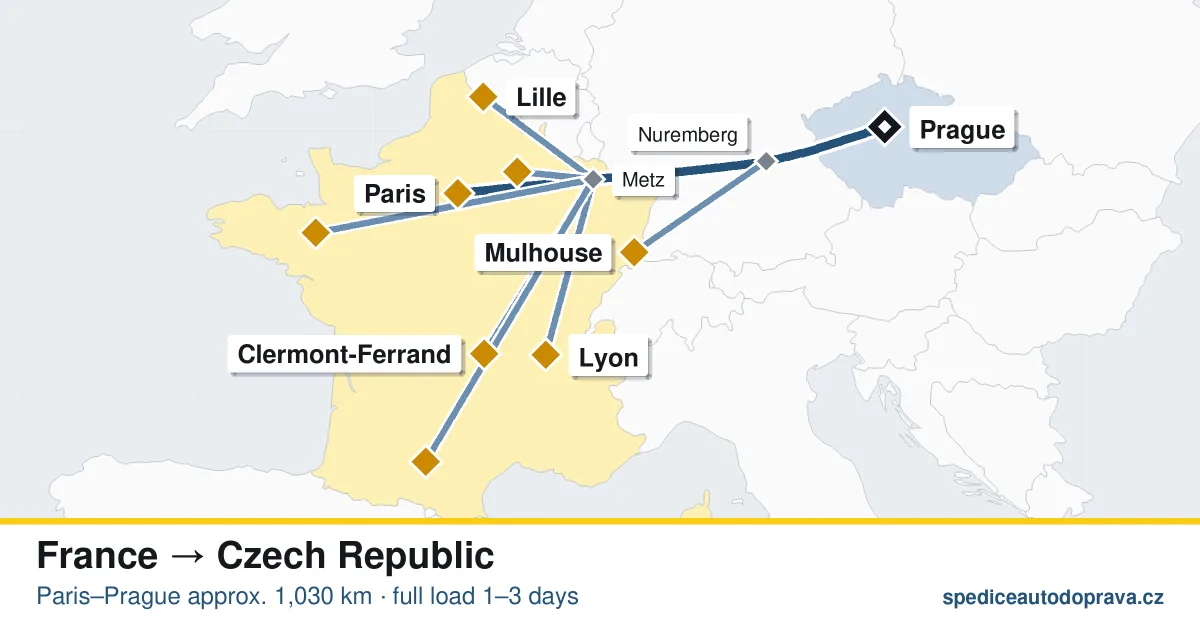
From France we bring cosmetics, chemicals and pharmaceuticals, tyres and plastics, dairy products and animal feed, glass and wine to the Czech Republic. A full load from Paris to Prague (about 1,030 km) usually takes 1–3 days via Germany; goods from the Lyon area normally avoid Switzerland because of the customs border. Use the calculator for an indicative price and we will email a firm quote.
The French cities we bring goods from
French industry is about far more than Paris: for deliveries to the Czech Republic, the cities of the north, Alsace and the Lyon area matter just as much. The further a collection point lies from the German border, the more days the journey needs.
| City | Industry | What we typically carry from there |
|---|---|---|
| Paris | cosmetics and perfume, pharmaceuticals, wholesale | cosmetics, medicines (often temperature-controlled), stock from wholesale and e-commerce warehouses |
| Lyon | chemical and pharmaceutical industry | chemicals, medicines; plastic components from nearby Oyonnax |
| Lille | food, packaging, distribution | food, glass and packaging materials, stock from retail distribution centres |
| Clermont-Ferrand | tyre manufacturing | tyres, often loaded loose |
| Mulhouse | automotive, chemicals | car parts, chemical and metal products |
| Reims | champagne houses | champagne |
| Rennes | Breton food industry, car plant | dairy and meat from Brittany and Normandy, animal feed, car parts |
| Toulouse | aerospace | aerospace components |
Tyres from France are often floor-loaded loose, without pallets, in a mega trailer so that every bit of volume is used. Dairy and meat need a reefer, while bagged feed is fine in a curtainsider. Champagne, like wine from Bordeaux and other regions, falls under excise rules – see wine and beverage transport. For car parts with tight delivery windows there is a separate page on automotive parts transport.
Why trucks from France go through Germany

From Paris the usual route runs via Reims and Metz to Saarbrücken, then on through Mannheim and Nuremberg to the Waidhaus/Rozvadov crossing. From northern France trucks often cross Belgium, where vehicles over 3.5 t pay a distance-based toll, and continue via Cologne and Frankfurt.
From the Lyon area and the French Alps the shortest way would be through Switzerland. But Switzerland is outside the EU, so the goods would need a transit declaration and customs formalities at two borders, on top of a steep heavy vehicle charge and strict night and Sunday bans. Trucks from south-east France therefore usually go through Alsace and Baden-Württemberg instead.
Whichever route is taken, Germany charges its Toll Collect motorway toll and bans vehicles over 7.5 t on Sundays. A lorry loaded in France on a Friday afternoon will therefore normally reach the Czech Republic on Monday or Tuesday.
When lorries stand still in France
| Period | Ban for vehicles over 7.5 t |
|---|---|
| every weekend | Saturday 10 pm to Sunday 10 pm on the whole network |
| public holidays | 10 pm the evening before to 10 pm on the day |
| selected summer Saturdays (July and August) | additionally 7 am to 7 pm |
| selected winter Saturdays (February and March) | 7 am to 6 pm, Auvergne-Rhône-Alpes region only |
The French government sets the exact summer and winter Saturdays afresh every year. Some goods, such as perishable food, are exempt. Watch out for holidays the Czech Republic does not share: 8 May, 14 July, 11 November and Ascension Day.
Tolls and other French specifics
French motorways are run by concession companies, and most charge by distance. Lorries pay electronically at the toll plazas, and a few newer stretches are already barrier-free (flux libre). Trunk roads off the motorway network are mostly free for goods vehicles. Vehicles over 3.5 t must carry blind-spot warning stickers on the sides and rear – the carrier takes care of that.
Corsica and the overseas departments
Corsica is part of France and of the EU VAT area, but goods must first cross by ferry to the mainland, usually to Marseille, Toulon or Nice. The overseas departments, such as Réunion, Martinique and Guadeloupe, belong to the EU yet sit outside its VAT area. Consignments from there need a customs declaration and travel by sea; we handle such shipments to order.
Single pallets from France travel by groupage, which takes longer than a full load. The main transit country is covered on our page about freight from Germany, and other countries are in the EU overview. Price your shipment from France in the calculator.