Freight from Denmark to the Czech Republic
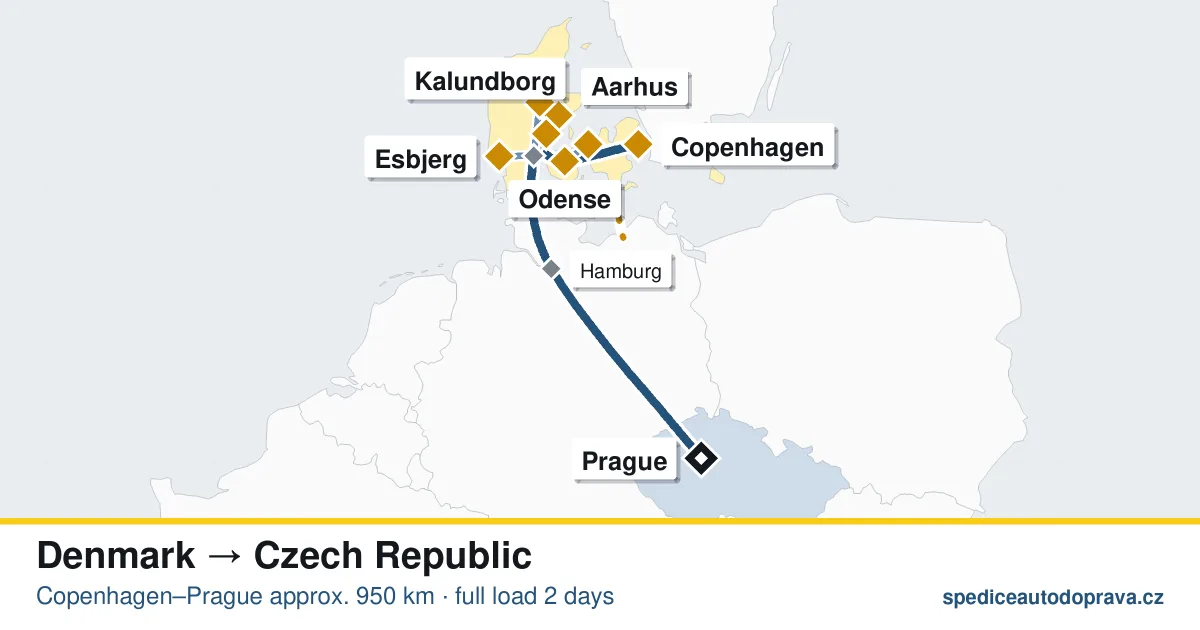
From Denmark to the Czech Republic we mostly move food and animal feed from Jutland, pumps and industrial equipment, pharmaceuticals from the Copenhagen area, and furniture. A full load from Copenhagen to Prague (about 950 km) takes roughly 2 days, either on the Gedser–Rostock ferry or overland through Jutland and Hamburg. We source the truck from our contracted carriers; the calculator gives an indicative price and we email a firm quote.
Denmark’s industrial cities, from Copenhagen to Esbjerg
For a small country, Denmark exports a remarkably wide range of goods. Pharma and technology dominate on the islands, food and engineering in Jutland – and the trucks we book for each city differ accordingly.
| City | Industry | What we typically carry from there |
|---|---|---|
| Copenhagen | pharmaceuticals, biotech, design | medicines and lab supplies in a temperature-controlled truck, design lighting and furniture |
| Kalundborg | pharmaceutical and enzyme production, refinery | enzymes and biotech ingredients, pharmaceutical intermediates |
| Odense | robotics and automation | robots, automation equipment and engineering components, often by groupage |
| Aarhus | dairy, food processing, wind energy | dairy products and cheese by reefer, parts for the energy sector |
| Horsens | pork processing | chilled and frozen pork |
| Bjerringbro | pump manufacturing | pumps and pumping systems on pallets or in crates |
| Esbjerg | fishing port, offshore wind | fish and seafood products by reefer; large wind turbine parts only as abnormal loads on request |
Furniture, plastic goods and animal feed are also collected from smaller towns right across Jutland; we often combine them with a further pick-up on the way south.
Pharmaceutical and biotech goods usually travel at 15–25 °C with a continuous temperature log. Mention this in your enquiry, as not every carrier working the Scandinavian lanes has such a trailer free.
Gedser or Jutland: which route?
The choice depends mainly on which end of the country the goods are collected from.
- Gedser–Rostock ferry – from the southern tip of Falster the ship reaches Rostock in about two hours, followed by motorway via Berlin and Dresden to Prague. For loads from Copenhagen and Zealand this is normally the shortest option.
- Overland through Jutland – from Aarhus, Kolding or Odense the truck heads south on the motorway past Flensburg to Hamburg. No ferry booking and no waiting at the port.
- Rødby–Puttgarden ferry – a short crossing of the Fehmarn Belt, around 45 minutes, useful when the truck continues via Hamburg or picks up more cargo in northern Germany.
The Fehmarn Belt tunnel is under construction, but the latest announcements put its opening no earlier than 2031. Until then we plan around the ferries and the Great Belt bridge linking Zealand and Funen.
Meat, cheese and feed from Jutland
Jutland is the heart of Danish farming and food processing. Pork and dairy products travel in a reefer set to the temperature the shipper specifies. Abattoirs and dairies work to tight loading slots, so we schedule the truck to arrive with time in hand. Fresh meat and dairy are exempt from Germany’s Sunday lorry ban, which means a weekend arrival in Rostock or Hamburg does not hold the shipment up. Pelleted animal feed in sacks on pallets can go in an ordinary curtainsider unless the product carries a temperature requirement. For when to choose an insulated or a refrigerated trailer for longer-life food, see our page on food transport.
Danish road tolls are charged per kilometre
Since January 2025 Denmark has replaced the time-based Eurovignette with a distance-based toll for lorries over 12 tonnes. The charge depends on the vehicle’s CO₂ class and weight, and is higher in designated environmental zones in the larger cities (Copenhagen, Aarhus, Odense, Aalborg). On top of that come the Great Belt bridge and the ferry ticket. The carrier pays all of these, and they are built into the price we quote you.
Danish loads, from one pallet to a whole trailer
One to six pallets go by groupage; the consignment is usually cross-docked in Germany and takes a few days longer than a full load. For 7–18 pallets we look for a part load, and from about 18 pallets a whole 13.6 m trailer with 33 pallet spaces makes sense. Light, bulky furniture and plastic goods fit best in a mega trailer with extra internal height; for advice on protecting furniture in transit, see furniture transport.
Denmark uses the krone but is fully in the EU, so an invoice and a CMR note are all you need. The exceptions are the Faroe Islands and Greenland, which are outside the EU. For routes further north see freight from Sweden; every other country is listed in our EU overview. For a ballpark figure on a Danish load, use the calculator.